 LATW AI Translation for Polylang
Best Polylang
AI translation add-on
Bring your own OpenAI key. Every job runs server-side in the background, Elementor pages are translated field by field, and nothing is guessed about what counts as text.

 Gutenberg




What it does, and how
Everything here ships today - no roadmap items on this list.
Polylang decides what's translatable, not us
On Polylang Pro we call Polylang's own export services - the machinery behind its XLIFF export - and hand the result back to its translation model, which builds the target post, links it and syncs taxonomies. On free Polylang the same rules run through our own walker.
130 widget types, field by field
Repeaters, dynamic tags and v3 atomic elements included. Layout settings never reach the model, so they cannot come back changed.
Queue it, then close the laptop
Every job runs on your server. Lose your wifi and the run carries on where it left off - no tokens burned on a batch that died halfway.
Everything it touches
Whatever Polylang is configured to translate - rebuilt from the original, never from a copy.
Pick your model
Balance quality against cost per run.
Glossary
Pin brand terms and product names once - applied to every translation.
Context & custom prompt
Describe your site and tone, or replace the system prompt entirely.
Outdated-translation flags
Edited the original? Every stale language is marked for a one-tick re-run.
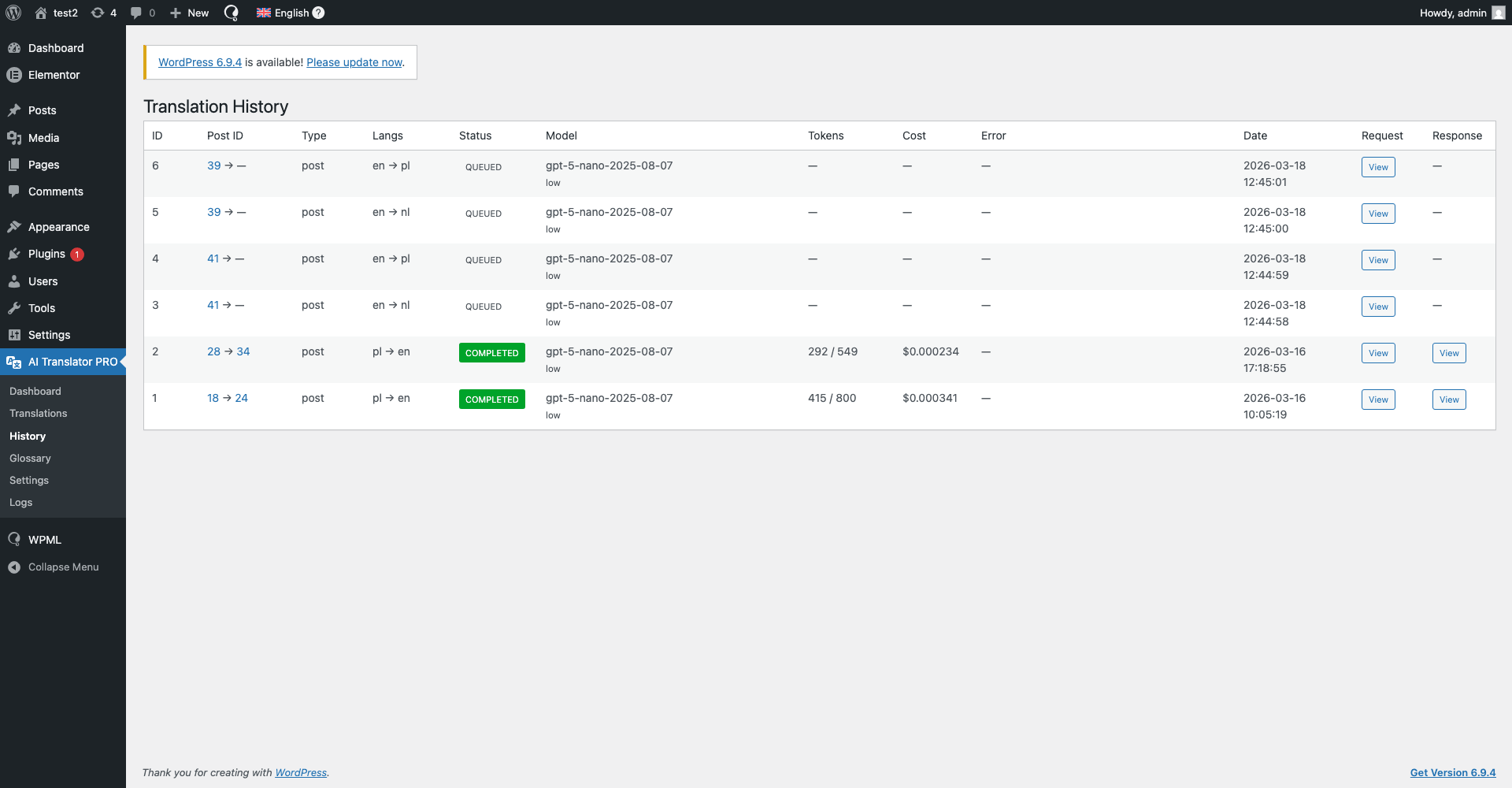
History, tokens and cost
Every job with its status and what it spent. Technical logs stay on your server.
Your own API key
Content goes straight from your server to OpenAI - never through ours.
What it actually costs
No credits, no per-word pricing, no character caps. You pay OpenAI for the tokens you use. Move the sliders to estimate yours.
Estimate only. Assumes ~3,000 words per article, input tokens at 2x word count and output tokens at 1x word count, priced at gpt-5.4-nano rates ($0.20 per 1M input tokens, $1.25 per 1M output tokens), multiplied by the number of target languages. Your actual cost depends on your content, the model you choose and OpenAI pricing at the time of use. The plugin licence is separate.
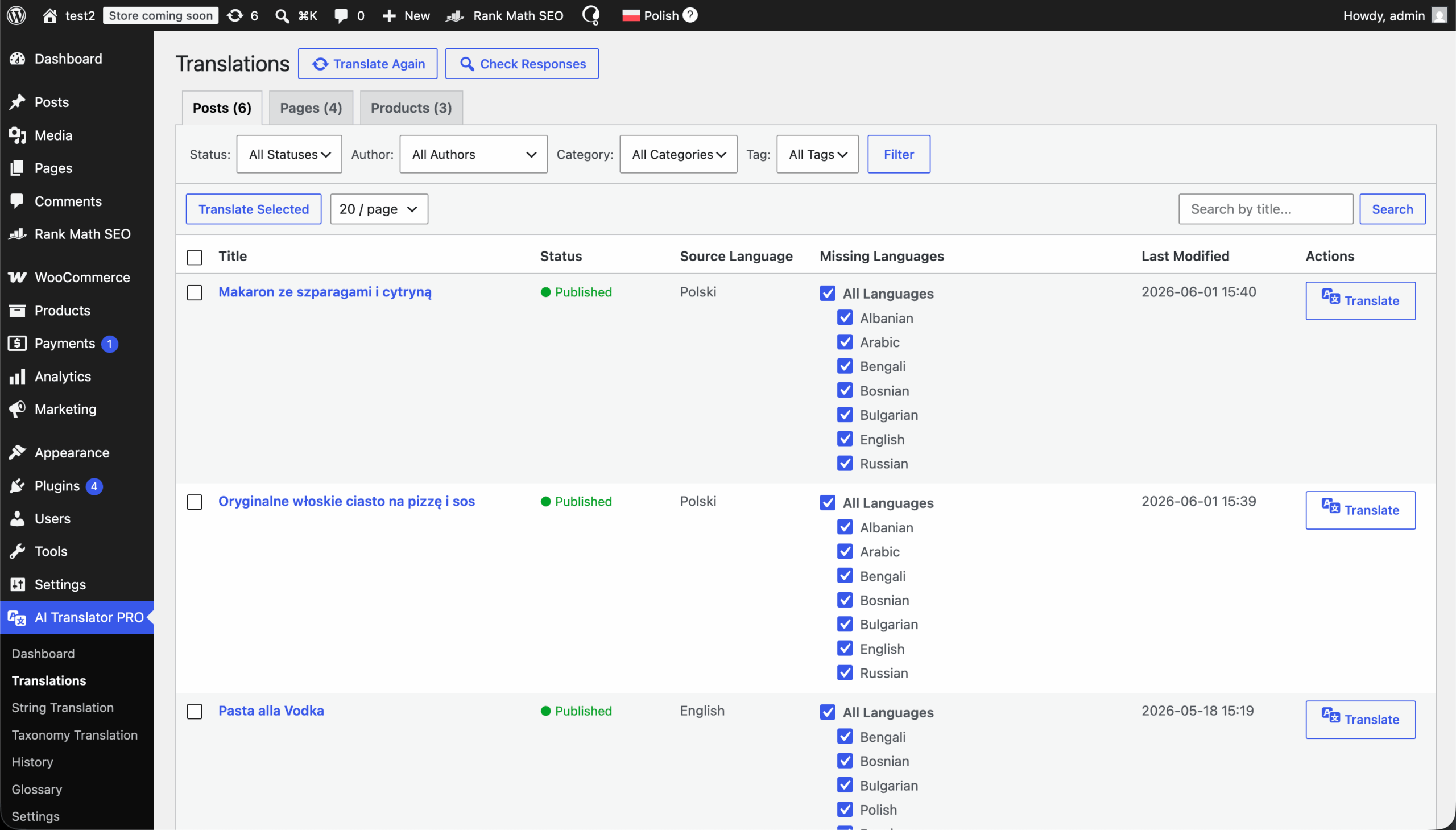
Four simple steps to start
Start translating immediately without unnecessary configuration.
Get pluginInstall & activate
Upload the .zip in Plugins > Add New on a site that already runs Polylang or Polylang Pro.
Add your OpenAI key
Paste your key, pick a model and choose which target languages you want.
Add website context (optional)
Describe what your website is about, your tone of voice and any terms the glossary should pin.
Enter License Key
Navigate to the plugin Settings > API Key and paste your license key from this dashboard.
Translate
Select content and submit for translation.
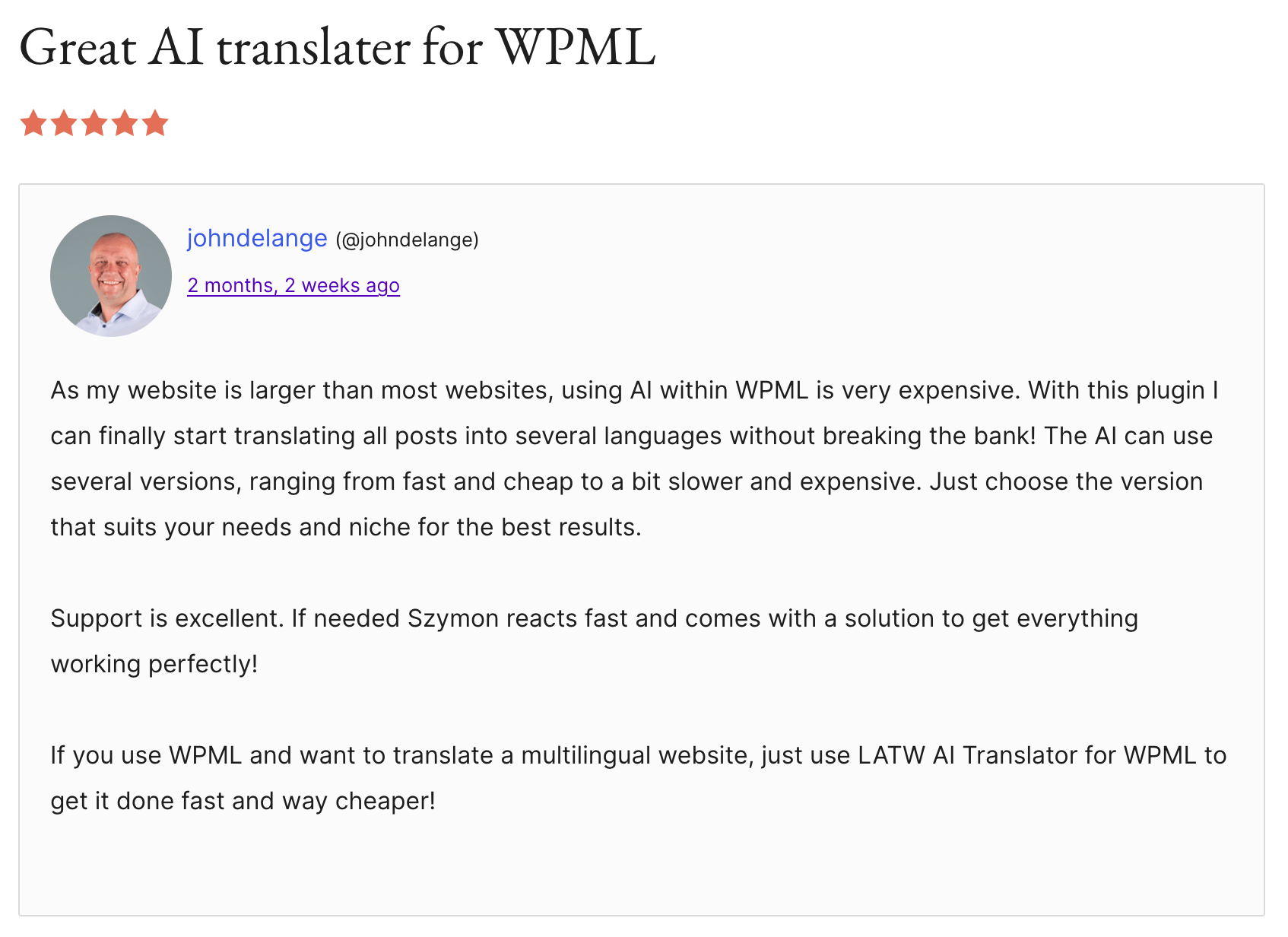
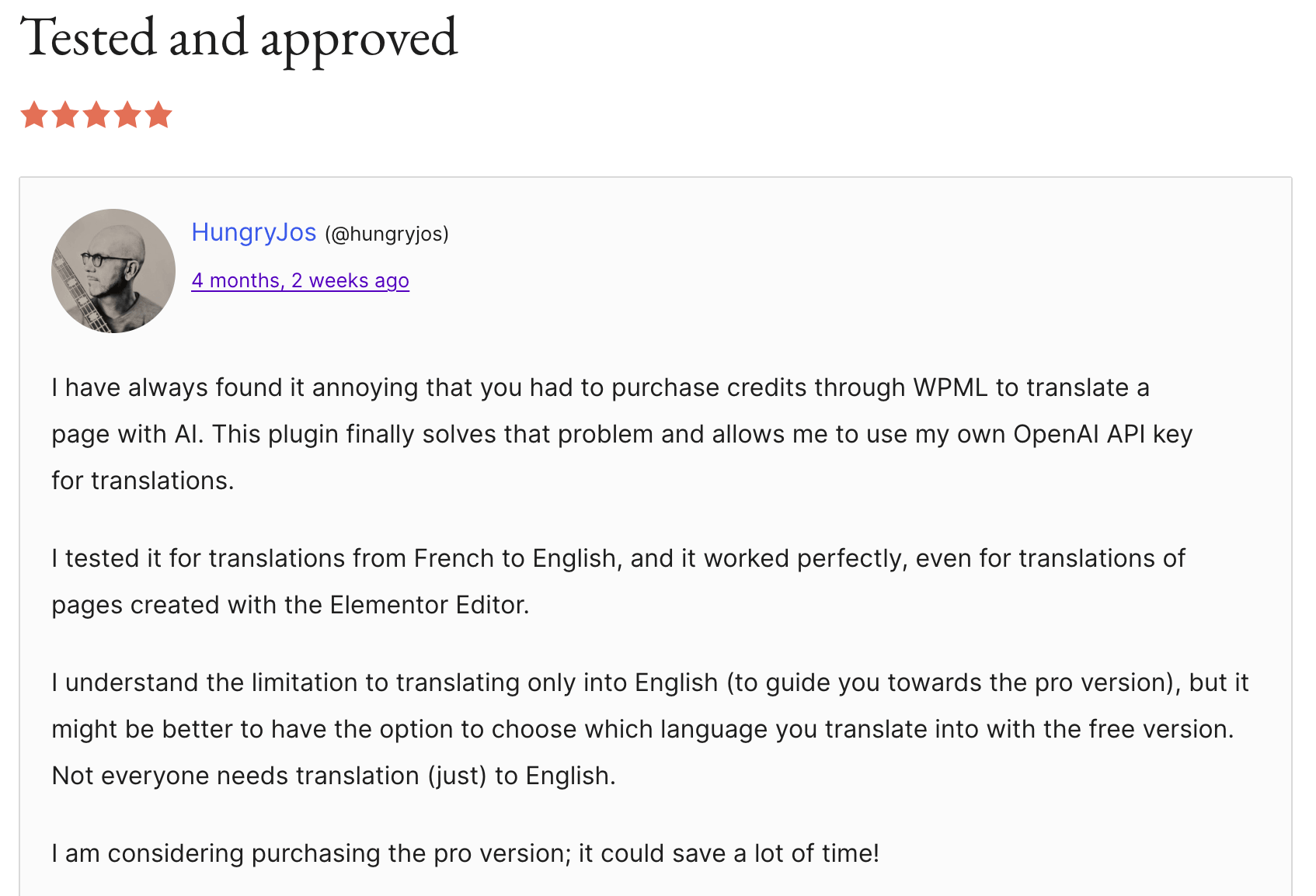
Loved by developers and site owners
Real reviews from WordPress.org and feedback users sent us by email.
Check reviews on WordPress.org →









I'm Szymon
I've been coding for about 8 years, and honestly, I just enjoy sitting in my room and building things. Apps, plugins, side projects… especially the kind that make work easier, faster, or less annoying.
The first plugin started as an internal tool for another project of mine - Wishgram. We wanted to reach more people with our blog in different languages, but startup budgets are tight and premium auto-translation was way too expensive for us. So I built my own solution for automatic translations. After using it for a while, I realized how ridiculously good it was - and keeping it to myself just didn't make sense.
My goal is simple: build plugins that help people translate WordPress sites cheaply, quickly and with real quality.
Pricing
Works with Polylang and Polylang Pro
On Polylang Pro the plugin hands extraction and reassembly to Polylang's own export and translation services, so it stays in step with whatever Polylang supports. On free Polylang it uses its own walker built on exactly the same rules.
Frequently asked questions (FAQ)
Can't find what you're looking for? Reach out to support directly.
Do I need Polylang Pro, or is free Polylang enough?+
Free Polylang is enough. The plugin works on both editions. On Polylang Pro it additionally delegates extraction and reassembly to Polylang's own export and translation services, which keeps it in step with whatever Polylang supports; on free Polylang it uses its own walker built on the same rules.
Which page builders are supported?+
Elementor is fully supported, along with Gutenberg and classic content. Divi, Bricks, WPBakery, Beaver Builder and Oxygen are not supported yet - and rather than half-translate them, the plugin detects them and refuses the job with a clear message, so you never end up with a broken layout.
Do I need my own OpenAI API key?+
Yes. You provide your own key, and your content goes directly from your WordPress site to OpenAI. The plugin author never receives, stores or processes your content.
What does it cost to translate my site?+
The licence plus whatever OpenAI charges for the tokens you actually use. There are no credits, no per-word markup and no character limits imposed by the plugin - you pay OpenAI raw API rates.
What happens if I close the browser mid-translation?+
Nothing. Jobs are queued on your server and submitted to OpenAI in the background, so the run continues without you. If your site itself has a hiccup, the queue resumes.
Can I re-translate content I have already translated?+
Yes. Every language stays selectable on the list, with a tick when it is done and a warning marker when the translation is older than the original. Re-running replaces the translation and keeps the same linked post.
Will it overwrite edits I made to a translation by hand?+
Only if you deliberately re-translate that language. Re-running a translation rebuilds it from the source, so manual edits to that language are replaced - translate first, polish afterwards.
Are AI translations accurate enough to publish unreviewed?+
We recommend reviewing before publishing. Output from modern GPT-5 models is strong, and a glossary plus a website-context description improves consistency a lot, but it is still machine translation.
How does licensing work?+
Licences are domain based - one licence, one domain - in packages of 1, 2, 5 or 10 domains, billed yearly.
What is the "fallback version"?+
The fallback version is the latest version of the plugin available at the moment your subscription started. If your subscription expires you can keep using this version indefinitely, but without updates or support. The plugin is never disabled.
Is my content sent through your servers?+
No. All requests go straight from your site to OpenAI's API using your own key. Translations live in your WordPress database and logs stay on your server.
What if a some elements is not translated?+
Write to us, and we'll do our best to add support for these elements within 2 days.
Translate your Polylang site this afternoon
Add your OpenAI key, pick your languages, queue the site and close the laptop.
Get plugin